


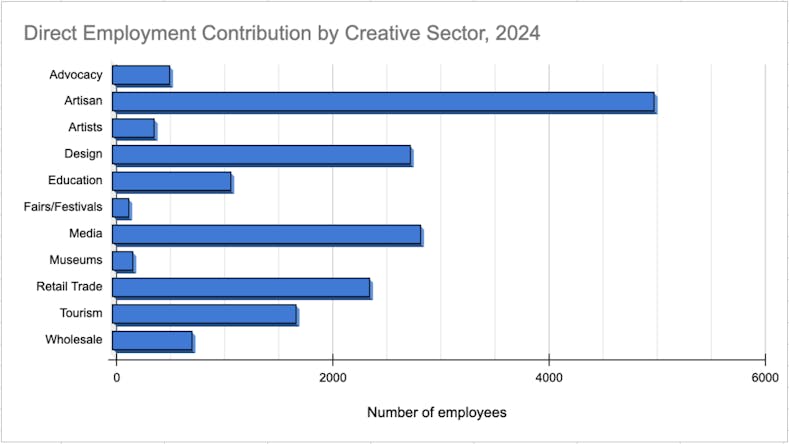
For the first time since 2014, a comprehensive study was conducted on Albuquerque’s creative economy, finding 17,680 workers directly employed by 2,457 creative businesses generating $1.1 billion in economic output in 2024. The sector makes up 4.4% of all local employment, the study found.
Administered by the University of New Mexico’s Bureau of Business and Economic Research, in partnership with the City of Albuquerque’s Department of Arts and Culture, the study defines the creative economy as the economic growth generated by producing and consuming art and other intellectual property with the value of these goods and services determined by the creators’ level of skill, expertise and talent.
The study was meant to discover what people in the creative economy would need to continue generating economic growth for the city, whether through policy changes, direct economic investment or other methods, according to Department of Arts and Culture Marketing Manager Tanya Lenti.
“The creative economy is both an economic driver and a core component of community identity. It contributes to local GDP, supports jobs across a wide range of occupations and generates spending that benefits local businesses and services,” Lenti said. “Creative work supports quality of life, strengthens cultural participation, attracts visitors and residents and encourages cross-sector collaboration.”
According to the study, a thriving arts and cultural scene can attract consumers and encourage them to buy goods and services within the creative economy as well as outside of it, making it a significant part of local economic growth.
The creative economy improves UNM, UNM BBER Senior Research Scientist Rose Rohrer said, the University provides education, location and opportunity for local creatives, and in return, artists make the community more vibrant.
“Students come to UNM for creative degrees, instructors teach in creative professions, UNM benefits from the creative economy and contributes to it,” Rohrer said. “UNM is a huge part of Albuquerque’s creative economy. We have multiple theaters, galleries, museums; we offer creative degrees like writing, dance, visual arts; and we partner with local organizations who are also a part of the creative economy.”
The study included input from creatives themselves that provided insight into their challenges related to affordability, professional development, infrastructure and connectivity that could inform future planning. The analysis also sought to reach part-time creatives and artists in lesser known creative fields, such as costume design, game design, stylists and tattoo artists.
“It is important not to only focus on the creative work in a museum, but the creative work that makes our everyday lives better,” Rohrer said.
Get content from The Daily Lobo delivered to your inbox
Penelope Loyd Sment is a freelance reporter for the Daily Lobo. She can be reached at news@dailylobo.com or on X @DailyLobo


