

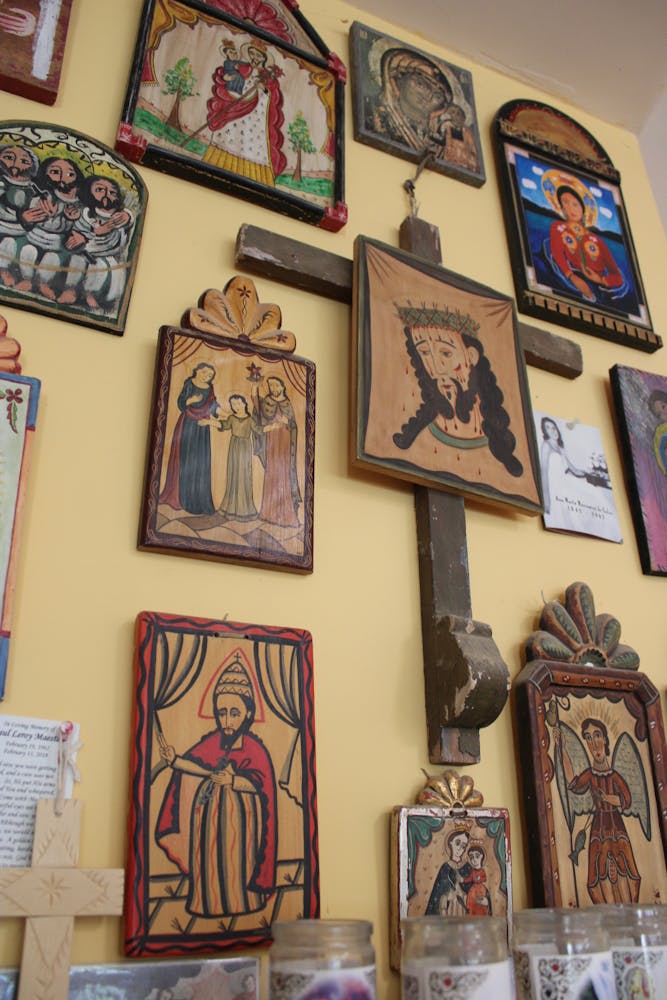
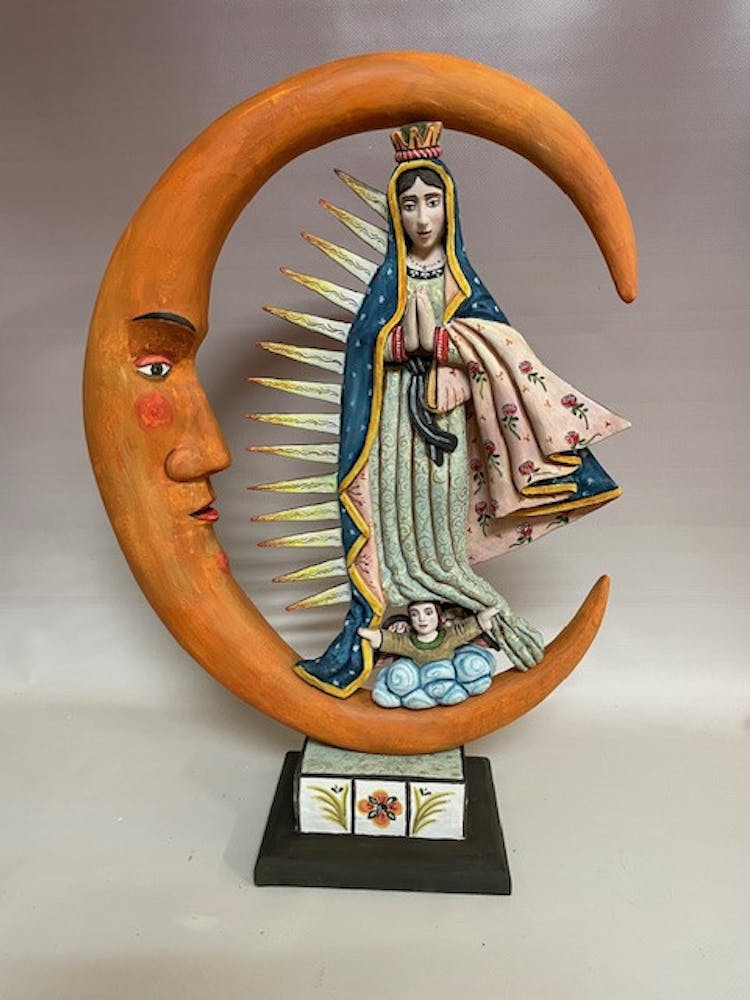
Throughout New Mexico’s history, art has been an integral part of telling the rich and vibrant stories and beliefs of its local people. One such style of art unique to the southwest is the craft of creating “santos,” the name given to multiple types of artistic demonstrations of figures in Catholicism, including paintings on wooden tablets known as retablos, carved statues called bultos and reredos, panel paintings often displayed behind the altar in churches.
Santos were originally displayed in the mission churches the Franciscans built when they came to the southwest, and typically depicted a saint, the Virgin Mary holding baby Jesus, or the Holy Family, Jana Gottshalk, curator and museum director of the Nuevo Mexicano Heritage Arts Museum, wrote in a statement to the Daily Lobo.
“Santeros and Santeras are extremely important to New Mexico culture. They carry on the artistic and cultural traditions in a way that no one else can. These artists are often deeply connected to history and have knowledge beyond what one can find in any book,” Gottshalk wrote.
Retablos and bultos became common items for devotion not only in churches, but homes as well, often depicting the patron saints of cooks, homemakers or woodworkers.
Over time, the art of “santo” creation became uniquely New Mexican, as artists developed their own processes with local materials, often using ponderosa pine or cottonwood bark for the tablet, paints made from the pigments of locally found plants, and piñon gesso, Victor Goler, a santero based in northern New Mexico, said.
“I grew up in a family of art conservators and restorers in Santa Fe and they put me to work at a pretty young age. In (my uncles’) conservation studios, they taught me how to carve, not necessarily how to carve faces and hands and things like that, but how to use the tools,” Goler said. “I was pretty self-motivated at a young age, and I'd go in there and just make my own toys and they saw that I had a knack for wood carving, so they put me to work on saints, many from New Mexico, but also from Mexico and the Caribbean.”
Inspired by the Chicano movement of the 1960s, New Mexican artists led a retablo revival, and the devotional objects remain a vibrant and popular expression of faith. Many artists continue the tradition of hand-painted retablos, along with contemporary artists from diverse cultural backgrounds who draw creative inspiration from the popular art form, according to Saint Mary’s College of California.
Goler has been creating retablos and bultos since 1988, becoming one of the most well-known artists to sell work in Santa Fe’s popular Traditional Spanish Market during the summer, he said.
Held annually since 1926, the Spanish Market has been a staple event for artists to display their talents and connect visitors to New Mexico’s Spanish settlement roots, according to The Spanish Market.
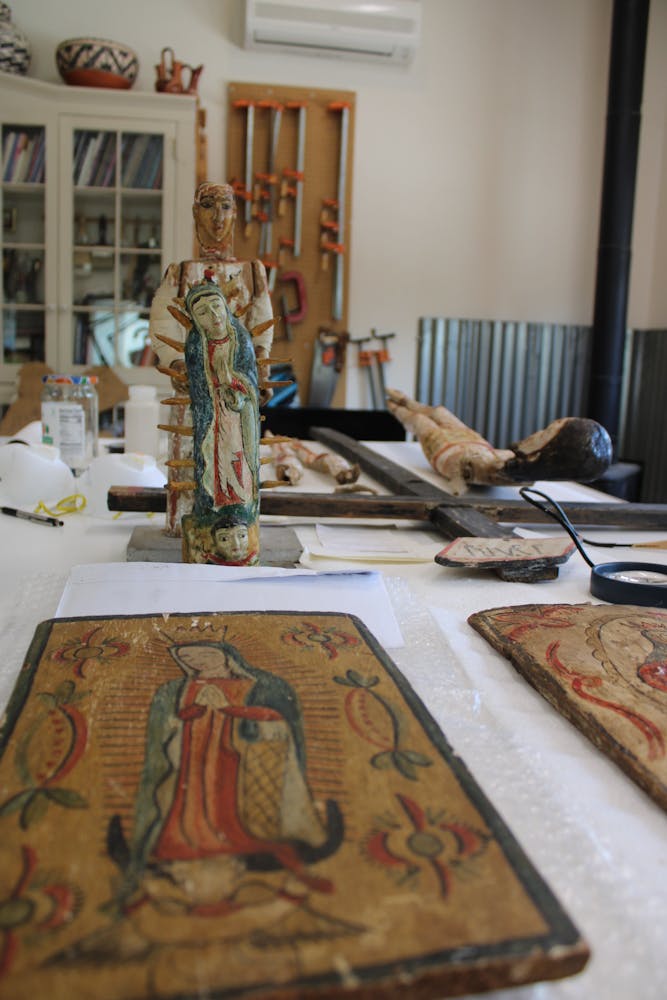
While participating in the Spanish Market each year, Goler become involved with the conservation of bultos and retablos in churches in New Mexico, helping to clean and take care of art pieces — so much so that his northern New Mexico studio is referred to as the “santo hospital” among the santeros and santeras of the community, he said.
“In conservation, you're preserving what is there. You're stabilizing the pigment, the gesso, the structure itself, but you're not changing the history of it. So, if it's missing fingers, you don't replace them. Even if the varnish isn't too dirty, you leave that original varnish. You have to weigh the options,” Goler said.
Retablos have evolved from representing not only religious figures, but also New Mexico history, with artists designing contemporary pieces depicting important fixtures of New Mexican history and way of life, Goler said..
Get content from The Daily Lobo delivered to your inbox
“I think it is interesting to note that the Chicano movement really marks the beginning of Santos as contemporary commentary. Luis Tapia is the best example of an artist who began to incorporate more of a narrative to the work and eventually used the traditional work to critique and comment,” Gottshalk wrote.
The community of santeros and santeras in northern New Mexico and southern Colorado is still thriving, as the art form has been passed down through generations and developed different styles, Goler said.
“Mentorship is also an important aspect to being a santero or santera, many artists dedicate themselves to passing down their knowledge of traditional materials and techniques to the younger generations. It’s a huge responsibility,” Gottshalk wrote.
Artist Corine Mora Fernandez began creating retablos and bultos after visiting the Spanish Market and finding artistic inspiration. In the 1980s, Mora Fernandez took a one-day class with Charles Carrillo, a well-known santero, on retablo painting, and quickly became fascinated with the art and began painting on their own.
“I think one of the (paintings) that I did a lot was Mary with Jesus, and then I got into the carving and doing the bultos, which came a few years later, and I really, really enjoyed the carving,” Mora Fernandez said.
Mora Fernandez participated in the Spanish Market until 2007, when health issues arose, but she has never lost her passion for creating santos and other artwork, she said.
“There was one time (my mother) and I went to the Spanish Market. I had never seen (retablos) before, and I fell in love with the traditional Hispanic art, and then I thought, ‘gosh, I think I could do that,’” Mora Fernandez said.
Editor’s note: Corine Mora Fernandez is the grandmother of Maria Fernandez, the writer of this article. Mora Fernandez was not involved in the reporting or writing of this article.
Maria Fernandez is the copy editor for the Daily Lobo. She can be reached at copy@dailylobo.com or on X @dailylobo


