

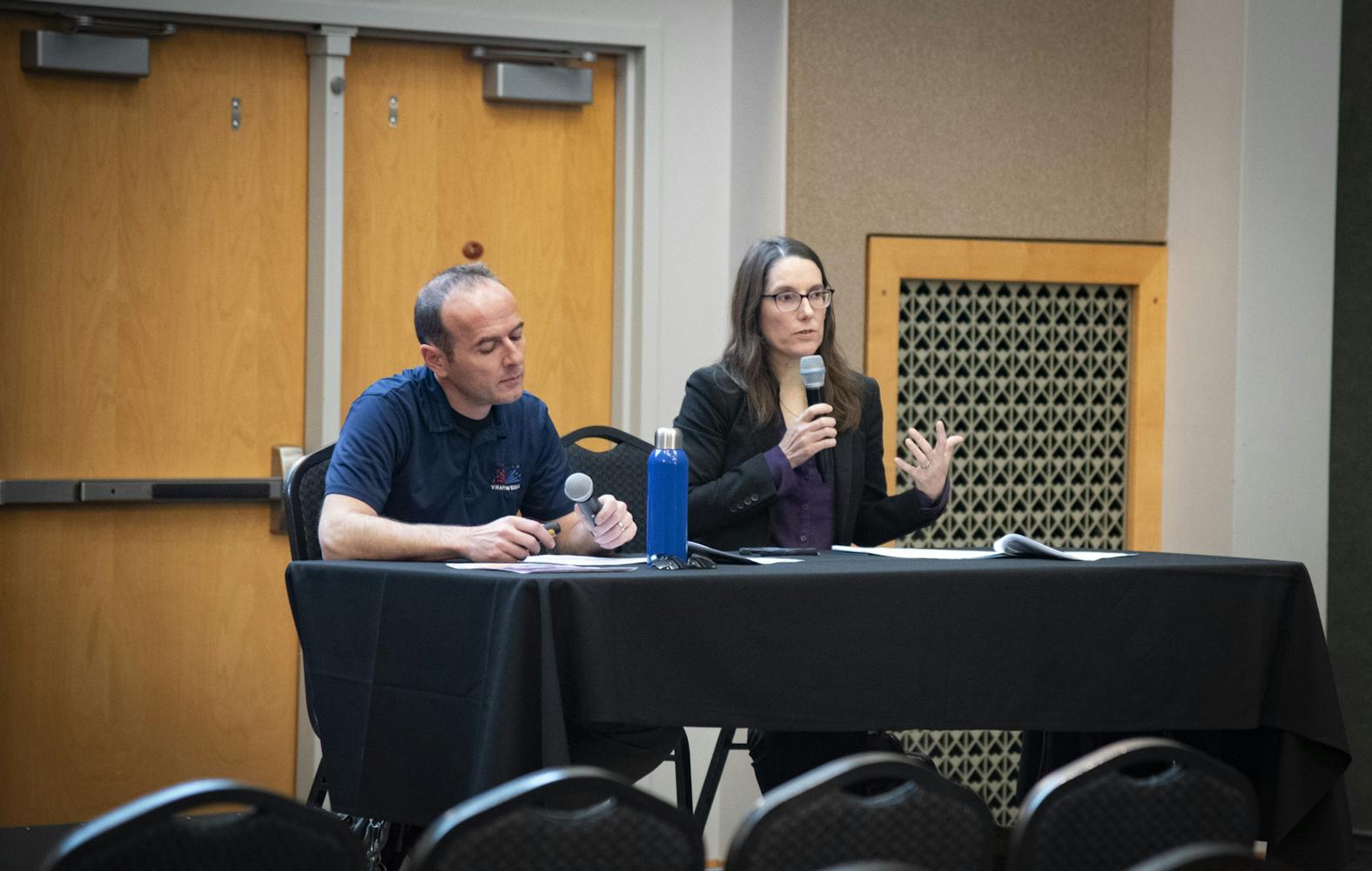
At a presentation last week at the University of New Mexico, local immigration attorneys Olsi Vrapi and Amber Weeks spoke to and answered questions from international students and employees, discussing topics ranging from citizenship pathways and travel plans to legal rights during an immigration raid.
The presentation was held at the Student Union Building on Oct. 14, and hosted by United Academics of UNM, the Graduate and Professional Student Association and the UNM Office of Academic Affairs. GPSA President Travis Broadhurst and UA-UNM President Ernesto Longa delivered opening remarks and Interim Provost and Executive Vice President for Academic Affairs Barbara Rodriguez attended the presentation.
Vrapi and Weeks are alums of the UNM School of Law and practice law at Vrapi Weeks Immigration Attorneys. Vrapi immigrated to the U.S. as a student from Albania in 1999.
During opening remarks, Longa said the faculty union had started an International Legal Defense Fund to cover expenses for non-U.S. citizen UA-UNM union members that face emergency immigration proceedings, to protect their right to due process.
Vrapi discussed President Donald Trump’s proclamation requiring a $100,000 payment for any new H-1B visa petitions submitted after Sept. 21, according to U.S. Citizenship and Immigration Services.
The H1-B program is a temporary nonimmigrant visa category that allows employers who can not obtain needed skills in the U.S. workforce to hire foreign professionals for “specialty occupations” that require at least a bachelor’s degree or equivalent, according to the U.S. Department of Labor.
On Oct. 16, the U.S. Chamber of Commerce, the largest U.S. business lobbying group representing over 300,000 businesses, filed a lawsuit claiming Trump’s proclamation is beyond his powers and will disrupt a complex visa system created by Congress, according to Reuters.
“Nobody’s going to pay that,” Vrapi said. “It’s a ‘go-away fee’. It’s for people not to apply.”
Vrapi said those without permanent legal status should avoid non-essential travel for the next few months because of how much is “up in the air” with the current policies regarding international workers.
Weeks said F1 and J1 visa holders — international students and students in an exchange program — are also subject to social media vetting for “terrorism,” particularly relating to pro-Palestinian or anti-Israel content, and are required to make all social media accounts public for vetting.
In Fall of 2024, there were 1,103 international students at UNM, according to the UNM Global Education Office.
“We’re advising caution with travel, particularly for F1 and J1; don’t travel if you don’t have to, because they are vetting social media for travel,” Weeks said, with Vrapi describing this social media vetting as an “ideological screening.”
Get content from The Daily Lobo delivered to your inbox
If someone is arrested or detained at the airport or boarder, Weeks said generally at airports, there’s no right to have an attorney.
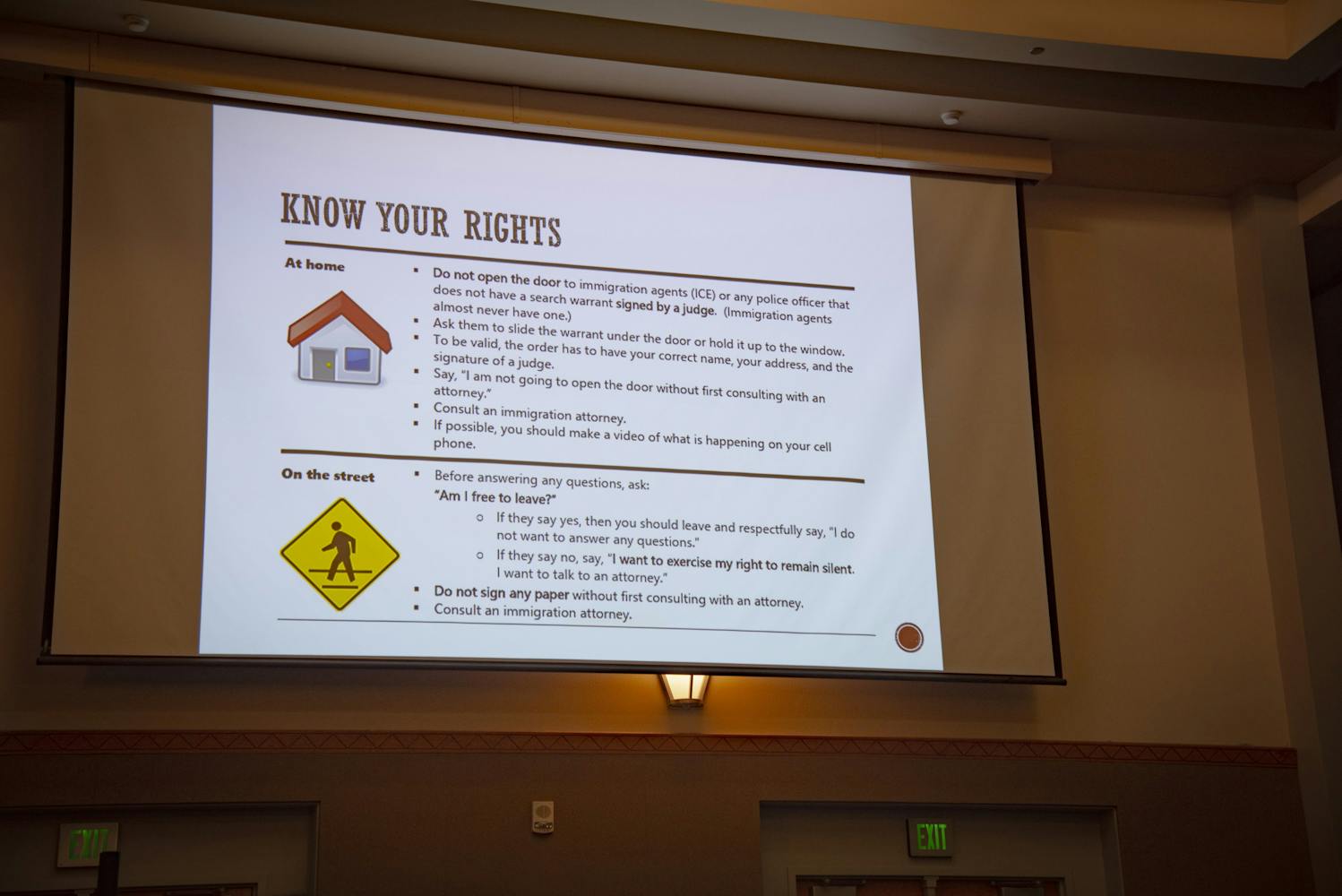
If approached and questioned by someone such as an Immigration and Customs Enforcement agent while walking around, Weeks said to first tell them you have no time and have to be somewhere like work or school, and that if they persist in questioning, the key phrase to say is “am I free to leave?”
“(The question) triggers like, ‘do you have the right to detain me or not?’ And so, ‘am I free to leave’. If they say yes, just go on about your business. If they say no, say ‘I want to exercise my right to remain silent,’” Weeks said.
The safest place to be if ICE agents appear is private areas, like those marked “employees only,” because they would need a warrant signed by a judge, Weeks said.
“Generally, ICE can also enter anything that the public can enter without a warrant. So if you’re at the public library or something like that, ICE can come in. If you’re in the lobby of a business, ICE can come in,” Weeks said.
In advising people of what to carry, Weeks said to have proof of lawful status and the phone number of an immigration attorney.
For people who don’t have status, if there is no way to prove they’ve been in the U.S. for two years, they are subject to expedited removal without due process, Weeks said. For those without status who have proof of having been in the country for 2 years, they are not subject to expedited removal and have the right to an immigration hearing.
“Give (traveling) some time until you know some of these chaos grenades, what I call (Trump’s policy changes), sort of fall out and so we kind of get some more clarity,” Vrapi said. “Not that things are going to get better, but at least we have clarity so we know what to plan for.”
Paloma Chapa is the multimedia editor for the Daily Lobo. She can be reached at multimedia@dailylobo.com or on X @paloma_chapa88
Paloma Chapa is the news and multimedia editor for the Daily Lobo. She can be reached at multimedia@dailylobo.com or on Twitter @paloma_chapa88


