


Over half of the state's cases are still uncertain as New Mexico gears up for reopening.
It's been a long few weeks. After a long month. In a year that began what feels like decades ago.
Protests, riots and police brutality are rampant in this week's headlines. Corruption. Deception. Violence. A military presence on campus that more closely resembles Fallujah circa 2003 than an institution of higher learning. Living nightmare after living nightmare.
And, oh yeah, a global pandemic. I almost forgot.
As New Mexico continues to roll out its reopening plans, it's getting easier (and way more comforting) to fall into a sense that COVID is in the rearview mirror.
With crowds swelling — be it for social revolution or casual outdoor dining — it's important we keep an eye on New Mexico's COVID cases post-quarantine and what they can tell us as we attempt to find a new normal.
Despite a number of personal gripes I've had with the usefulness of the state's COVID data dashboard, the New Mexico Department of Health (NMDOH) has, to its credit, done an adequate job in reporting the number of cases, deaths, hospitalizations and recoveries at the statewide level over the past few months.
And that stuff's pretty useful for understanding the current condition of the state's cases. A lot of us have seen somebody's Excel graph on Twitter showing the growth in deaths, hospitalizations or recoveries over time.
While all of those are fine and dandy bits of information to keep in mind, what really worries me most is the fact that a majority of New Mexico's cases fall into the other: cases in which people aren't dead, recovered or hospitalized, shown here as the "active, not hospitalized" group.
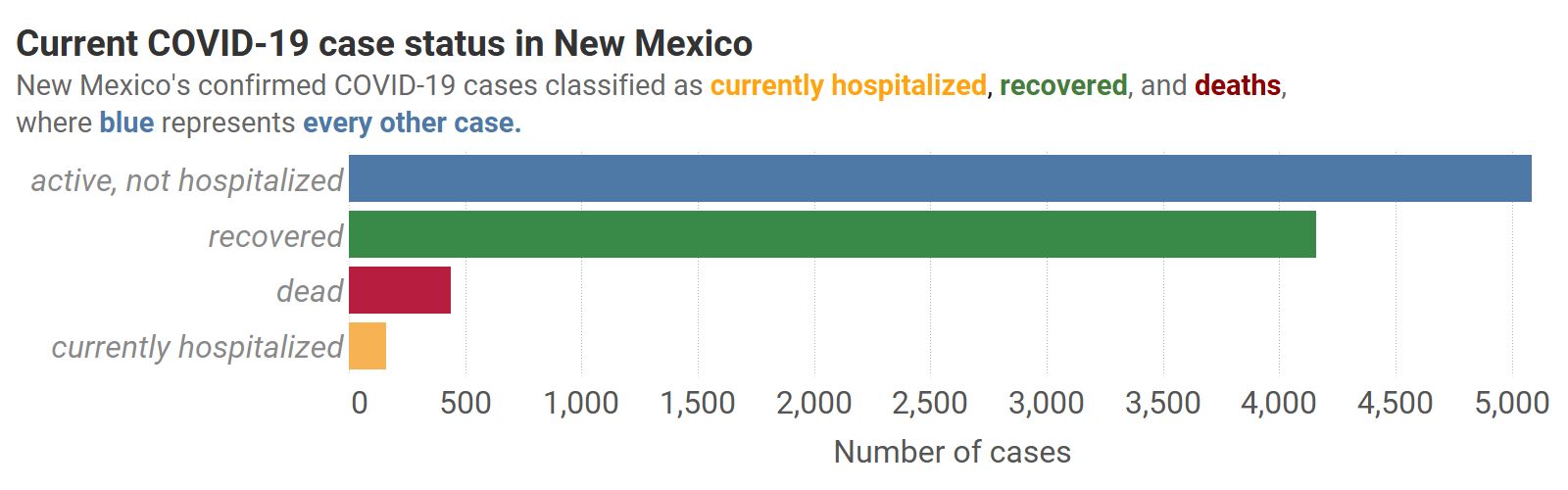
For the sake of illustration, let's assume that a recovered COVID patient, who by the CDC's definition has tested negative for the disease twice in a 24-hour span, is truly COVID-free. This assumption is somewhat conservative since it eschews any potential false-negatives or folks who may classify as having recovered only to get infected again.
In this hypothetical, cases that result in either a death or a recovery pose no immediate risk to spread the disease. Meanwhile, cases which at a given point are currently hospitalized naturally offer significantly less risk of transmission simply due to the fact that they're properly sequestered and receiving care.
That leaves the uncertain group, being the majority of cases which are still active but not hospitalized. Over time, as New Mexico's testing capacity increased and asymptomatic people were encouraged to seek testing, the portion of cases in this "other" category has gradually dropped.
For context, here's a graph showing the portion of NM's overall cases belonging to each group — "recovered," "currently hospitalized," "dead" or "active and not hospitalized" — through June 15 and starting on April 2, the day that the NMDOH began reporting the first three on a daily basis.
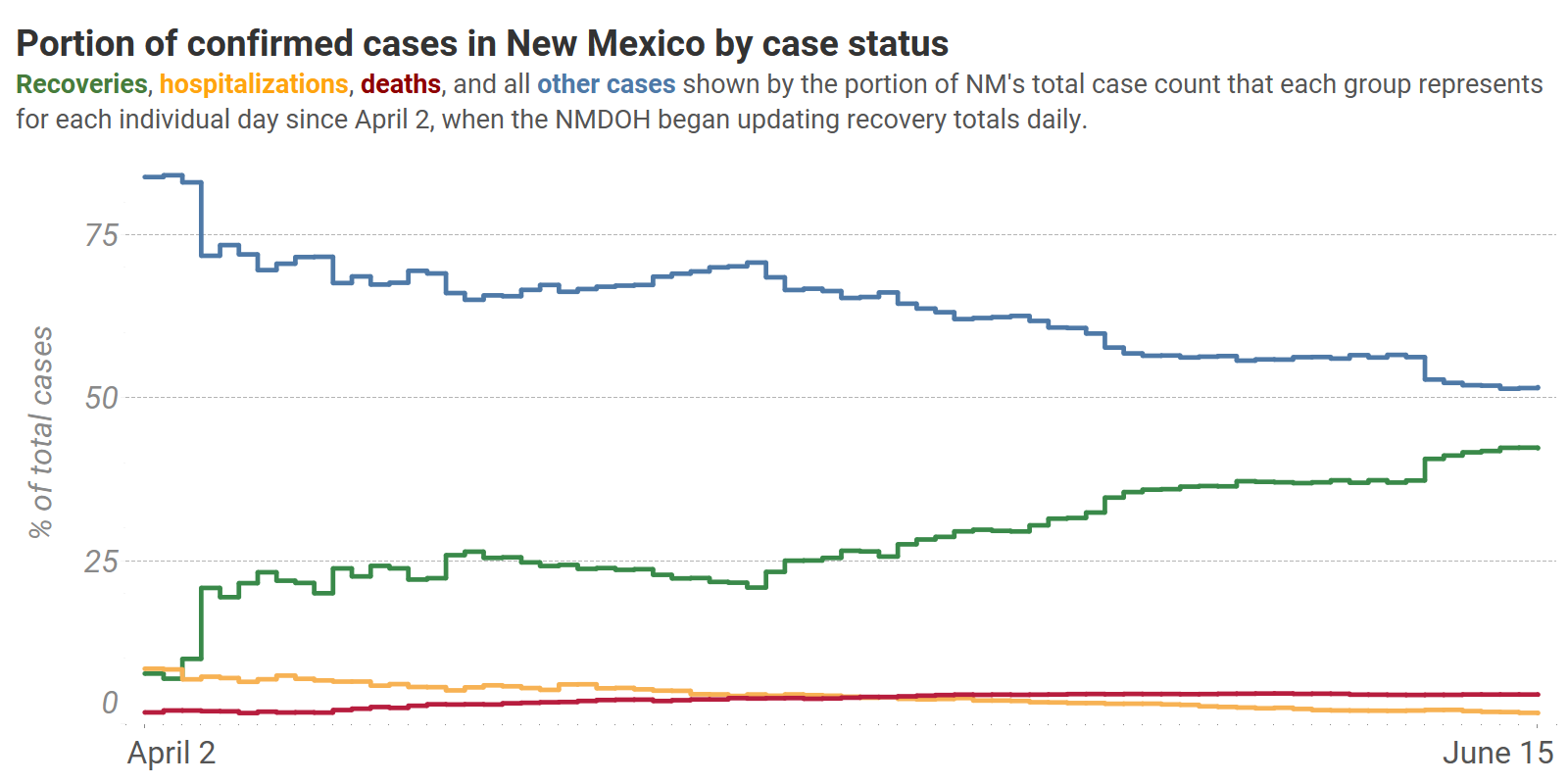
For the first three weeks of May, the "recovered" group was making steady upward progress. Which makes sense. You need to find cases before you find recoveries, so logically it makes sense that recovery growth lags behind case growth.
That is, until the past few weeks, where it leveled just as New Mexico began ramping up and rolling out its reopening plans (aside from the line shot downward after the latest installment in a strange week of result reporting).
Even after a particularly unpredictable week of NMDOH reporting, we're hovering right around 51% of cases being active and not hospitalized. As the state reopens, that means a majority of the cases that New Mexico has seen over the past three months are still uncertain, with a result yet undetermined.
More importantly, these cases pose a significantly higher risk of spreading the disease following the onset of loosened restrictions. And there's a bunch of 'em.
Here's what New Mexico's cases look like as of June 14.

That's a lot of blue.
And you may be thinking, "Why don't we just tell those blue cases to stay home?"
Right now, that roughly 51% group of active, not hospitalized cases in New Mexico consists of 5,084 people.
And that's the catch. It is extremely unlikely that the state of New Mexico will compel over 5,000 people who've been cooped up for three months of stay-at-home orders to just stay home.
It stands to reason that at least some of those 5,000-plus people will be out and about, potentially spreading the disease.
It's also important to realize here that while New Mexico has garnered praise for its top-tier testing density, it also just recently reached the 10% testing mark less than two weeks ago, and as of now the state has reported just 267,000 tests performed on a population of about 2.1 million.
On top of this, we can't forget that some studies suggest that at least 30% (though more likely north of 40%) of COVID-positive individuals are asymptomatic. Given that, it's entirely possible — actually, scratch that, overwhelmingly likely — that, in a country and state wherein true testing numbers still reflect such a small portion of the overall population, there must be a contingent of folks who have the disease without even knowing it.
In other words: New Mexico has been recording new cases every day since March 11. We're quickly approaching 10,000 cases. And that's not even scratching the surface of the hundreds or perhaps thousands more which haven't been detected.
And we're ... reopening? Now? Even after seeing what's happening in the states that have already reopened?
Mind you, New Mexico's case growth hasn't really even made a real decline yet. Cases are coming in more or less at the same rate that they've been coming for weeks.
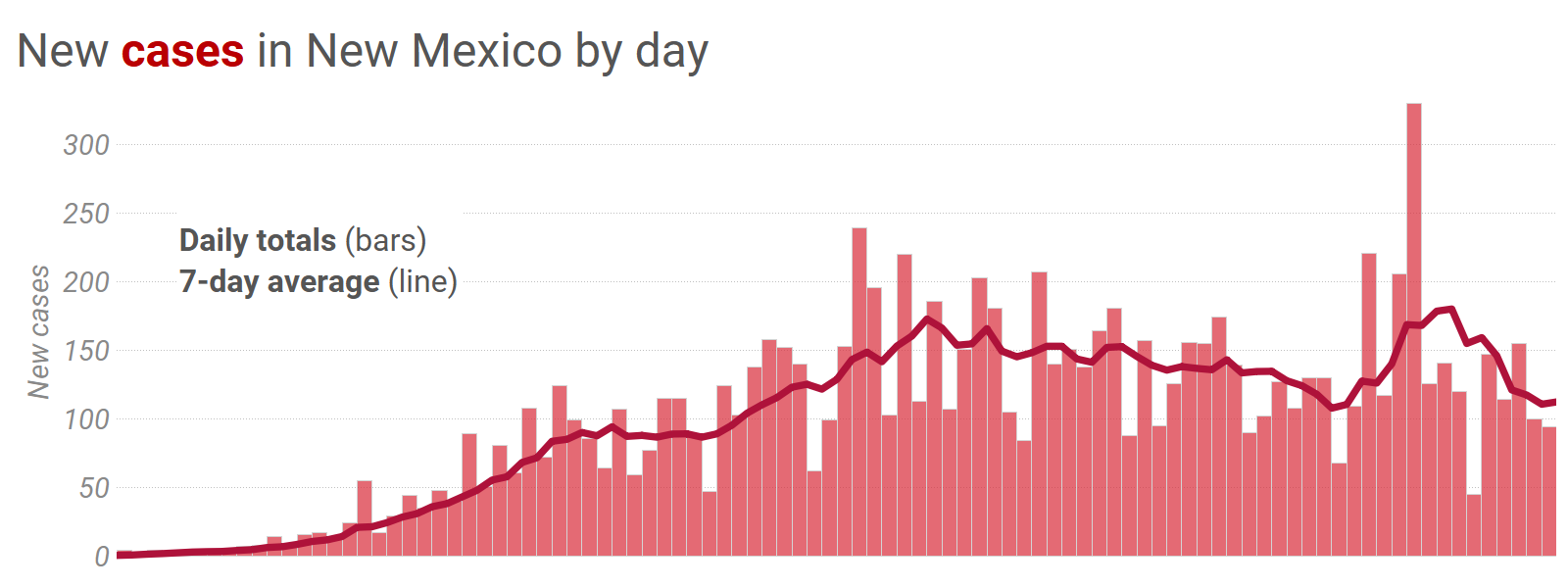
And, again, I can't stress this enough: It is absolutely impossible that every confirmed case represents every actual case, so this is just scratching the surface.
With folks desperate to return to "normal," contact and increased transmission is inevitable, just like in most every other state which has tested the post-quarantine waters so far.
So while thousands of New Mexicans start finally going out to their favorite breweries again, let's just keep in mind that this thing is very much still here, and probably here to stay for a long time.
Of course, it's not quite that simple. This active, not hospitalized group does have a few caveats like false positives, unconfirmed recoveries and the fact that active cases aren't evenly distributed throughout the state.
Then again, with testing percentages this low, we can't stress enough how likely it is that hundreds or thousands of New Mexicans have none the wiser been or are currently carrying it.
What this group really has is uncertainty, and that uncertainty is a risk to you, me and everyone else as the state reopens.
Chances are, you won't see those active cases milling around oh-so-conveniently outlined in blue. In fact, you could easily miss them entirely.
Here's a hint: They look like accidentally rubbing shoulders with someone at the store. Or a waiter handing over the check at your favorite newly-reopened restaurant. Or the gas pump at Circle K. Or literally any doorknob.
And if you don't want to listen to me — a 21-year-old journalism student with no background in epidemiology or infectious disease aside from a few retweets — I wouldn't blame you.
I'd feel more inclined to blame you, though, if you didn't listen to the group of over 500 epidemiologists surveyed by the New York Times last week, the majority of which said they didn't expect to safely dine-in at a restaurant for at least 3-12 months, or the even larger majority which doesn't plan to stop wearing a face covering for at least a year.
So, as we get ready to dive into a reopened society, just remember this: COVID isn't going anywhere.
COVID doesn't show itself in color-coded icons. COVID doesn't take days off. COVID doesn't care that you're tired of quarantining, and COVID definitely doesn't care that you haven't gone to the gym in a few months.
Quarantine fatigue is real. And I get it. But as we adjust to a new reality and start to reopen, listen to the experts and adopt a harm-reduction model to approaching our new normal. I would advise against keg stands for the immediate future.
Joe Rull is the data editor at the Daily Lobo. He can be contacted at data@dailylobo.com or on Twitter @rulljoe
Want more graphs? Joe updates a page full of NM-based COVID-19 graphics every day, which can be found here. Want to know when you're looking at a bad graph? Read his primer on COVID data coverage here.


